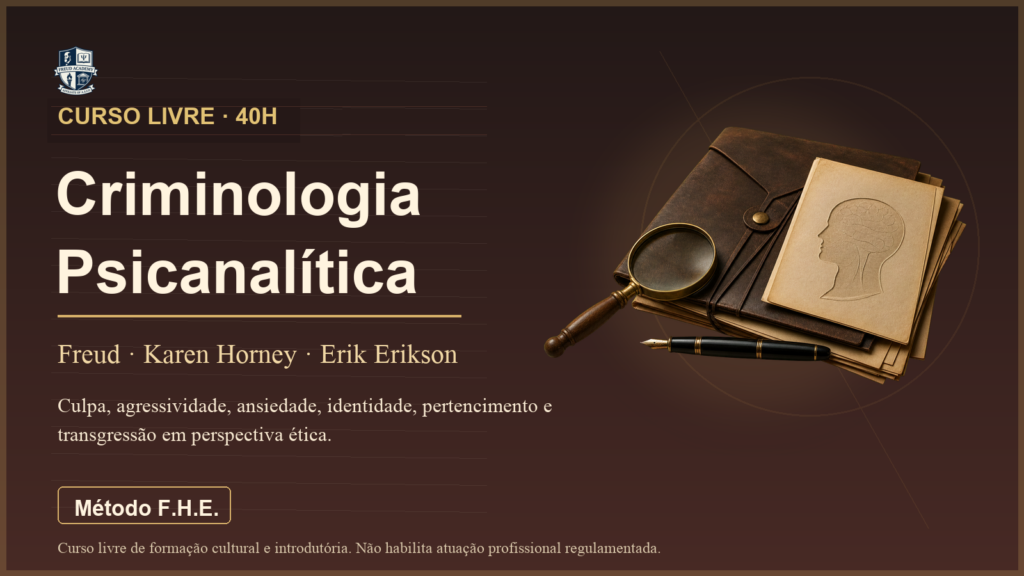
Psychoanalytic Criminology
Understand crime beyond the law through Freud, Karen Horney and Erik Erikson, with a serious reading of guilt, aggression, anxiety, identity, belonging and transgression.
This course presents an ethical, accessible academic and psychoanalytic reading of criminal behavior, without sensationalism, amateur diagnosis or operational content about crimes.
Online training in 4 thematic units and 13 lessons.
- Online open course
- 40 hours
- 4 thematic units
- 13 lessons
- Digital certificate
- Investment: US$199.00
An ethical reading of crime, the subject and the law
The proposal is to study Freud, Karen Horney and Erik Erikson as authors who can illuminate psychic conflicts, neurotic needs, shame, identity and the relationship with the law.
This course does not train criminal experts, official investigators, police officers, legal psychologists or professionals qualified for regulated technical practice. It is an open, theoretical and complementary course.
What you will study
Freud
The unconscious, conflict, guilt, aggression, the superego, repetition and discontent in civilization.
Karen Horney
Basic anxiety, hostility, neurotic needs, control, power, isolation and resentment.
Erik Erikson
Identity, shame, belonging, adolescence, psychosocial development and the relationship with the law.
F.H.E. Method
An analysis framework using Freud, Horney and Erikson to read fictional cases without diagnosing real people.
Applications
Study of violence, control, revenge, humiliation, groups, status, transgression and responsibility.
Ethics
Distinguishing theoretical hypotheses, diagnosis, expert assessment, investigation and regulated professional practice.
Curriculum
The course is organized into 13 lessons across 4 thematic units. The training begins with the foundations of criminology and advances to a psychoanalytic reading of crime, law, guilt, aggression, social control, prevention and modern criminal policy.
Unit 1 — Criminology, the subject and the law
Lesson 1.1 — Criminology, science, the subject and the law
In this lesson, students understand the object of criminology and its relationship to crime, the offender, the victim and social control. The psychoanalytic reading adds the question of how the subject, law, guilt, desire, aggression and social life are related.
- What criminology studies
- Crime, offender, victim and social control
- The difference between a legal crime and a social phenomenon
- External law and psychic life
- The superego, guilt and aggression
- The contribution of psychoanalysis to thinking about the subject before the law
Lesson 1.2 — Criminological knowledge, criminal law and internal law
This lesson distinguishes criminology, criminal law doctrine and criminal policy. Students learn that criminal law applies rules, while criminology investigates causes, effects and social responses to crime. Psychoanalysis enters as the study of internalized law.
- Criminology, criminal law and criminal policy
- The role of criminological knowledge
- Punishment, deterrence and subjectivity
- Internal law, the superego and guilt
- Freud, Totem and Taboo, and ambivalence toward the law
- Responsibility and the symbolic limit
Lesson 1.3 — Criminology, criminal policy and psychic responsibility
This lesson deepens the relationship between crime, criminal policy and responsibility. The focus is on understanding how to hold someone responsible without turning punishment into revenge or subjective understanding into an excuse.
- Criminal policy and public choices
- Legal guilt, ethical guilt and psychic guilt
- Freud and Civilization and Its Discontents
- To explain is not to justify
- Recidivism, repetition and responsibility
- Limits, reparation and reduction of further harm
Unit 2 — History of criminology and a critique of determinism
Lesson 2.1 — The pre-scientific stage, the body and the danger of determinism
This lesson presents the pre-scientific stage of criminology, including physiognomy, phrenology, early anthropology, moral statistics and the Cartographic School. The aim is to show the danger of trying to locate crime in bodily marks or external signs.
- Physiognomy and phrenology
- The body as a supposed sign of danger
- Moral statistics and criminal cartography
- Social fear and projection
- Determinism, labeling and selectivity
- Psychoanalytic critique of the fantasy of absolute control
Lesson 2.2 — The Positive School, Lombroso and the psychoanalytic critique of the born criminal
In this lesson, students study Lombroso, Garofalo and Ferri, understanding the historical importance and limits of the Positive School. The central critique concerns the idea of the born criminal and the risk of turning science into stigmatizing classification.
- Positive School
- Lombroso and the born criminal
- Garofalo, Ferri and social defense
- Atavism, heredity and determinism
- Psychoanalytic critique of the criminal essence
- Body, history, identification and subjectivity
Lesson 2.3 — Intermediate schools, environment and relational defense
This lesson shows attempts to move beyond biological positivism through environmental, social and relational explanations. Psychoanalysis, especially through Karen Horney, helps explain the relationship between insecurity, hostility and defense.
- Intermediate and environmental schools
- Social environment, education and opportunity
- Horney and basic anxiety
- Relational defense and hostility
- Identity, belonging and environment
- Individual, society and complex causality
Unit 3 — Explanatory models of crime
Lesson 3.1 — Criminal biology, the body and the limits of organic causality
In this lesson, students study criminal biology and the limits of organic explanations of conduct. The course recognizes the importance of the body, impulsivity, trauma, development and substance use, but rejects any biological determinism.
- Criminal biology
- Anthropometry, biotypology and neurophysiology
- Body, impulsivity and development
- Influence is not destiny
- Freud, drive and repetition
- Body, history and subjectivity
Lesson 3.2 — Criminal psychology, psychoanalysis and the limits of interpretation
This lesson distinguishes criminal psychology, psychoanalysis, psychopathology, psychiatry, diagnosis, expert assessment and interpretation. Students learn that psychoanalysis can offer hypotheses about meaning, defense, guilt and repetition, but must not be used for improvised diagnoses.
- Criminal psychology and psychoanalysis
- Diagnosis, expert assessment and interpretation
- Freud, anxiety, symptom and repetition
- Horney, defense and pride
- Ethical limits of interpretation
- Understand without acquitting, and hold responsible without simplifying
Lesson 3.3 — Criminal sociology, groups, belonging and identity
In this lesson, crime is studied through criminal sociology, the Chicago School, anomie, conflict theories, critical criminology and subcultures. Psychoanalysis contributes to thinking about groups, identification, belonging and identity.
- Chicago School
- Social disorganization and the city
- Anomie and blocked social goals
- Groups, subcultures and belonging
- Freud and Group Psychology
- Erikson, identity and recognition
Lesson 3.4 — Social control, the labeling approach, shame and identity
This lesson presents theories of social control and labeling. Students learn how society defines deviance, applies labels and produces subjective effects on those named as dangerous, deviant or irredeemable.
- Formal and informal social control
- Labeling approach
- Howard Becker and labeling theory
- Goffman, stigma and identity
- Shame, the superego and negative identity
- Hold responsible without humiliating
Unit 4 — Criminal policy, prevention and harm reduction
Lesson 4.1 — Socialist criminology, inequality and social discontent
In this lesson, students study critical and socialist criminology, focusing on inequality, penal selectivity, capitalism, power, property and criminalization. Psychoanalysis contributes to thinking about social discontent, humiliation, resentment and the collective desire for punishment.
- Critical and socialist criminology
- Inequality and penal selectivity
- Baratta and Vera Regina Pereira de Andrade
- Freud and Civilization and Its Discontents
- Horney and competitive culture
- Violence as a symptom of a violent social order
Lesson 4.2 — Crime prevention, the Social State and recognition
This lesson presents crime prevention in the Social State governed by the rule of law, distinguishing primary, secondary and tertiary prevention. The focus is on building bonds, recognition, limits, belonging and protection without labeling.
- Primary, secondary and tertiary prevention
- Social State governed by the rule of law
- Recognition, limits and care
- Erikson, development and identity
- Winnicott, deprivation and delinquency
- Prevent without humiliating surveillance
Lesson 4.3 — Modern criminal policy, the symbolic limit and harm reduction
The final lesson discusses the foundations of a modern, rational, democratic and humane criminal policy. Students learn to distinguish limits from cruelty, accountability from revenge and prevention from abusive control.
- Modern criminal policy
- Symbolic limit
- Harm reduction
- Victim protection
- Accountability of the offender
- Reparation, prevention and critique of punitivism
- Crime, the subject and society considered together
Across 13 lessons, students follow an interdisciplinary training program that brings together criminology, psychoanalysis, sociology, criminal policy and social critique. The aim is not to turn psychoanalysis into a total explanation of crime, but to use it as a lens for understanding the relationship between the subject, law, guilt, aggression, shame, identity, belonging and responsibility.
The course rests on one central idea: understanding is not acquittal. Explaining an act does not mean justifying it. The psychoanalytic reading does not erase the victim, remove responsibility or replace criminal law. It adds depth to the study of the criminal phenomenon.
Who is this course for?
Designed for students and professionals interested in psychoanalysis, criminology, law, psychology, education, security and the humanities.
- Students of psychoanalysis, psychology and law
- Education and humanities professionals
- People interested in human behavior and culture
- Students seeking a theoretical, responsible and non-sensationalist approach
Begin your studies in Psychoanalytic Criminology
Access the online course, progress at your own pace and complete the training with a 40-hour digital certificate.
Frequently asked questions
Does the course include a certificate?
Yes. The course issues a digital certificate of completion for 40 hours of study.
How many lessons does the course have?
The course has 13 lessons organized into 4 thematic units, with a total workload of 40 hours.
Is the course recognized by MEC?
It is an open course, not an undergraduate or postgraduate program, and it does not qualify anyone for a regulated profession.
Do I need to be a psychologist?
No. The course is introductory and theoretical, for people interested in psychoanalysis, criminology, law, psychology, education and human behavior.
Does the course teach criminal investigation?
No. The course does not teach investigation, expert assessment, police practice or operational content about crimes.
Does the course discuss real cases?
Applications use fictional cases and focus on theoretical, ethical and educational reading.
Study crime, subjectivity and law with psychoanalytic rigor
Develop a serious, ethical and profound reading of guilt, aggression, identity, belonging and transgression.
Enroll now